
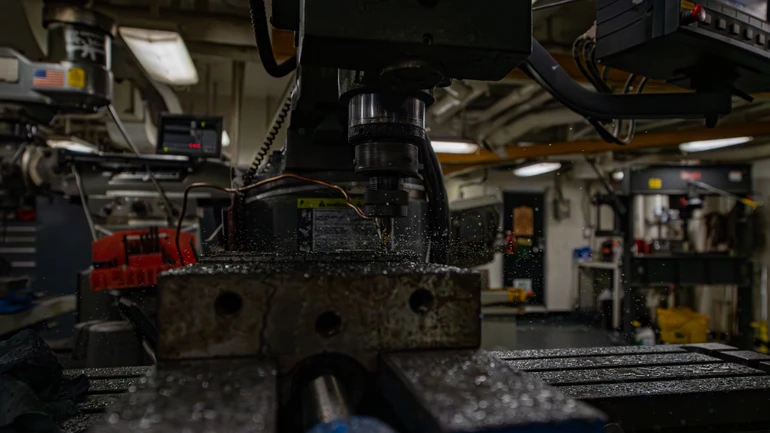
Precision CNC capacity is expanding across the U.S. aerospace and defense supply chain. In September 2026, several manufacturers announced new floorspace, machines, or regional sites aimed at complex flight hardware, sustainment parts, and build-to-print work. For small OEM and job shops, those headlines are a demand signal: primes and Tier 1s still need qualified machining partners who can hold print, schedule, and quality.
One clear example is Machine Sciences Corporation, an Oregon-based precision CNC manufacturer with Florida operations. On September 10, 2026, the City of Cedar Park, Texas, approved a performance-based economic development agreement for Machine Sciences to lease about 48,000 square feet at Cedar Tech I, create 70 full-time jobs, and invest roughly $31.9 million. The company specializes in complex, high-precision components for space, aerospace, and defense — including satellites, unmanned aerial vehicles, and advanced defense systems — and has reported roughly 20–30 percent annual growth in recent years.
That kind of investment is not happening in isolation. In early September, Seyer Industries ordered a second Starrag STC 1800 machining center to expand capacity for large titanium and high-performance alloy components used in aerospace and defense. Mid-month, GKN Aerospace broke ground on a $16 million expansion of its North Charlestown, New Hampshire engine-component plant, adding turning, surface finishing, and non-destructive testing so more process steps stay on one site. On September 22, KIHOMAC announced a planned $25 million, roughly 130,000-square-foot Oklahoma City facility to grow aerospace manufacturing and sustainment capacity supporting Tinker Air Force Base.
What small build-to-print shops should watch
- Capacity announcements often trail program ramp needs. When OEMs add floorspace and five-axis machines, RFQs for brackets, fittings, housings, and tooling usually follow.
- Buyers still filter on fundamentals: documented quality (AS9100 or equivalent where required), configuration control, inspection capacity, and honest lead times.
- Materials matter. Titanium, stainless, and other hard alloys show up repeatedly in these expansions — shops that already program and fixture those alloys are better positioned when overflow work appears.
- Proximity still helps. Regional clusters around depots, primes, and space campuses attract supplier visits and dual-source conversations.
None of this guarantees a purchase order. It does mean the market is still investing in U.S. precision machining. Shops that keep drawings clean, processes repeatable, and delivery dates real remain the ones OEMs call when a cell is overloaded.
Sources: City of Cedar Park (Machine Sciences expansion, Sep 10, 2026); MTDCNC (Seyer Industries Starrag STC 1800, Sep 1, 2026); Defence Industry Europe (GKN Aerospace North Charlestown expansion, Sep 16, 2026); Expansion Solutions Magazine (KIHOMAC Oklahoma City expansion, Sep 22, 2026).
