
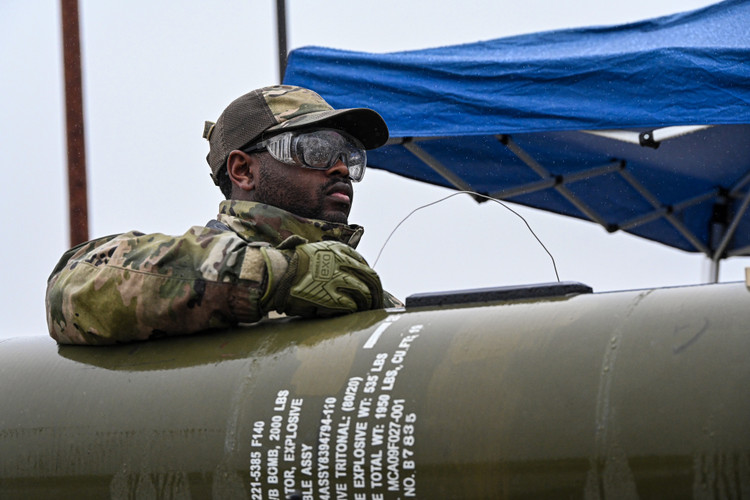
Hardened penetrator warhead cases are not a niche detail. They are the metal shells built to survive impact into bunkers and reinforced targets before the charge inside functions. On September 10, 2026, reporting covered a U.S. Air Force award package of roughly $149 million for large penetrator warhead case assembly production, split across four specialty forge and machining manufacturers in Ohio and Pennsylvania rather than a single prime.
The Air Force Life Cycle Management Center’s Attack Weapons Branch at Eglin Air Force Base ran the competition. Each awardee received a firm-fixed-price, cost-type indefinite-delivery, indefinite-quantity contract. Work can extend into September 2033 if options are exercised. As with many IDIQs, the initial obligation was a small placeholder — the real volume arrives as orders are placed over the life of the vehicle.
Why the split across specialty shops matters
When the government spreads case and component work across multiple forging and machining houses, it is buying redundancy and industrial-base depth. That pattern matters for small and mid-size shops that already live in
Multi-year munitions industrial-base work rarely starts with a cold RFQ alone. Shops that win follow-on machining and forge work usually already show CAGE-ready paperwork, AS9100 or equivalent discipline where required, and a track record on similar hardness, tolerance, and delivery problems. The demand signal to watch is not only the headline ceiling — it is whether the program is building a bench of specialty suppliers who can take task orders when production ramps.
If you are a Midwest machine shop or firearm OEM supplier watching Air Force armament sustainment, DLA Class IX pipelines, or prime subcontract packages, treat awards like this as a map: where the work is going, what quality bar is implied, and which specialties (forge, machine, special process) keep showing up on the award list.
Sources
News hook: U.S. Air Force large penetrator warhead case assembly awards totaling about $149 million across four specialty manufacturers (Defence Blog / related coverage, Sep 10, 2026). Background: Air Force Life Cycle Management Center Attack Weapons Branch, Eglin AFB; large penetrator warhead case production as hardened metal shells for bunker-busting munitions.
precision metalwork: forge partners, CNC houses, heat treat, and finishing. The story is not “only primes win munitions.” It is that specialty capacity — quality, schedule, and material discipline — can sit on multi-year vehicles when the program office needs it.
- Documented quality systems that survive audits
- Traceable processes on drawings, materials, and special processes
- Delivery history that supports surge without drama
- Clear points of contact for program offices and primes looking for capacity
